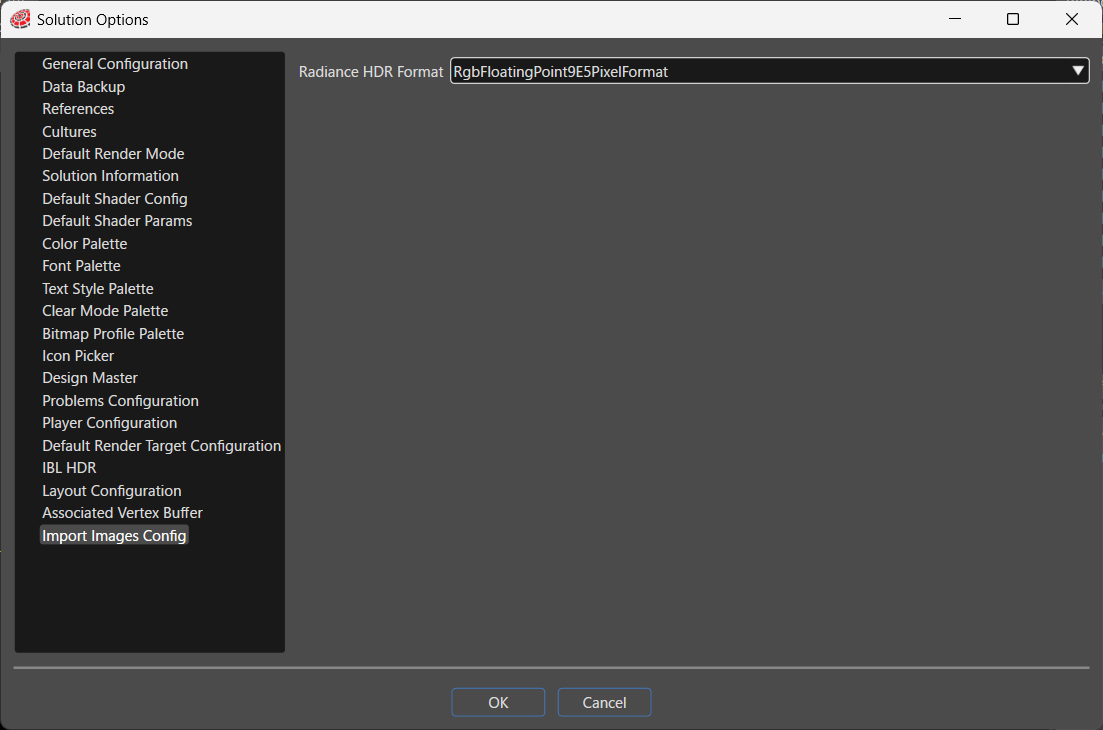
| Format | **Description** |
| RgbFloatingPoint9E5PixelFormat | A **shared-exponent** format (equivalent to GL\_RGB9\_E5) that stores a 9-bit mantissa per RGB channel and a single 5-bit exponent shared across all three channels. Each pixel takes **32 bits (4 bytes)** — one third of the footprint of a full RGB float texture. The format cannot represent negative values; its representable range is approximately 0–65,408. Best suited for HDR images that do not require an alpha channel, such as environment maps, skies, and backgrounds. |
| RgbFloatPixelFormat | Stores each RGB channel as a **32-bit IEEE 754 single-precision float**, for **96 bits (12 bytes) per pixel**. It offers the widest representable range (≈ ±3.4×10³⁸) and the lowest quantization error of all the formats listed here. Recommended for highest-quality authoring and for preserving the original fidelity of HDR source images, at the cost of the largest memory footprint among the RGB formats. |
| RgbHalfFloatPixelFormat | Stores each RGB channel as a **16-bit IEEE 754 half-precision float**, for **48 bits (6 bytes) per pixel**. Its representable range (≈ ±65,504) comfortably covers the dynamic range needed for HDR10 display content. It uses **half the memory of the full float format**, making it the recommended choice when balancing quality and footprint. |
| RgbaFloatPixelFormat | Extends RgbFloatPixelFormat with a **32-bit float alpha channel**, yielding **128 bits (16 bytes) per pixel**. Use this format when an HDR image must also carry alpha information (transparency, masks, or auxiliary data) at maximum precision. This is the largest format among the five. |
| RgbaHalfFloatPixelFormat | Extends RgbHalfFloatPixelFormat with a **16-bit half-float alpha channel**, yielding **64 bits (8 bytes) per pixel**. Use this format when both HDR tonal range and an alpha channel are needed, with half the memory of the full RGBA float format. This is the standard choice for HDR textures that require transparency. |
In an OpenGL ES 2.0 environment, none of the five pixel formats listed above are supported. If your solution contains any of these formats, a warning is shown in the **Problems** panel.